

Finding Purpose in Work Transitions: Career Changes, Sabbaticals, and Retirement.
Whether it is changing careers, going on a sabbatical, going on a parental leave, or retirement, making a big transition can take time and intentional efforts to successfully adjust.
Written by Anna Wong

Illustration by Kateryna Kovarzh.
Navigating Change Can Be Hard
Big career transitions can be tough, even if you are the one who decided on making the change. How do you find purpose and meaning in your next chapter?
How do you craft your work, so that you feel that you are contributing, feeling valued, and connected to others around you?
This blog talks about: Avoiding arrival fallacy (when we think we will be happy when we meet our goals); mattering (how we add value and feel valued); finding flow in our work.
Part One: Avoiding Arrival Fallacy
During school, I developed some sort of arrival fallacy where I thought I would be happy and fulfilled once I reached my goals. “Once I am done this licensing exam, I can finally relax.“ “Once I get the job, I will be happy.” “Once I find a better job, I will be happier.” And most recently, I have been dreaming of taking a sabbatical or retirement as my ultimate goal.
If happiness is always on the other side of the goal post, and we keep moving the goal post further each time, then we theoretically can never reach happiness.
Perhaps it is not about reach a certain milestone. It is about intentionally crafting your work now, so that you can uniquely contribute and also enjoy the areas of your life that bring you fulfillment.
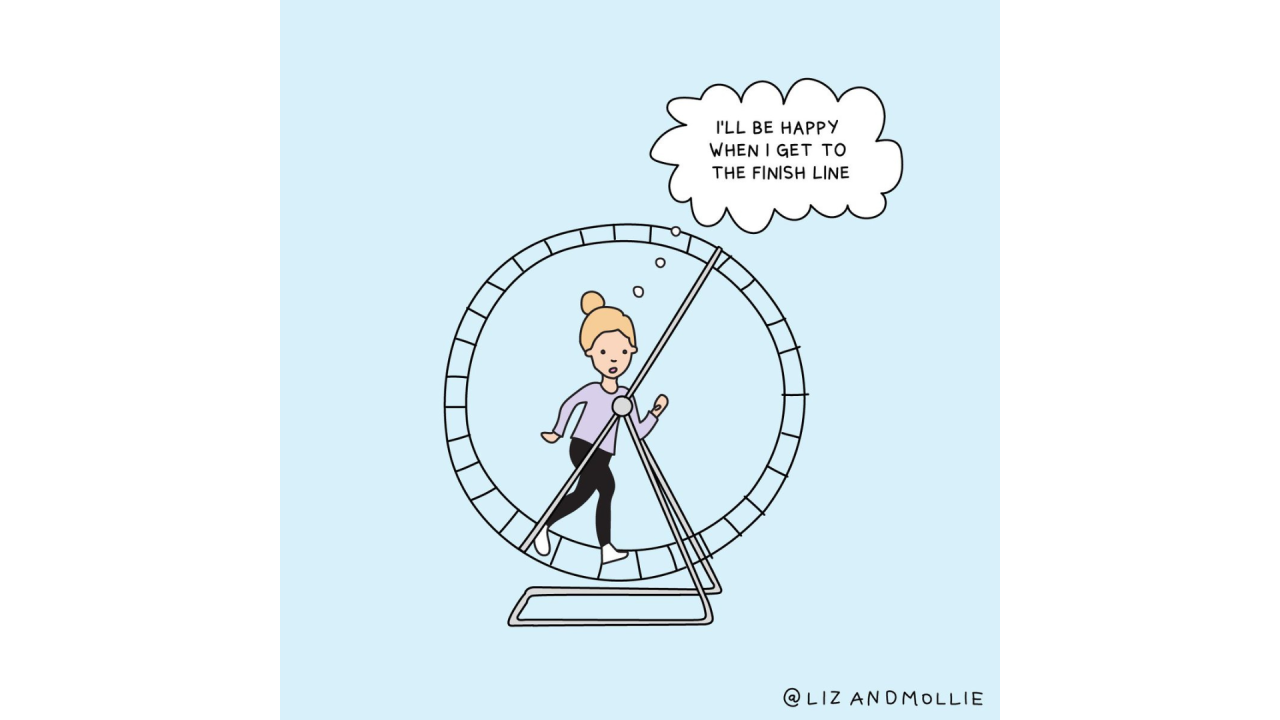
Figure 1. Image of a woman on a hamster wheel, thinking “I’ll be happy when I get to the finish line”. Illustration by @lizandmollie
Part Two: Feeling like We Matter
So how do we “enjoy the process”, not just the destination? How can we craft our lives so that we feel that we are adding value to the work that we do, and also feel valued? We can think about the concept of mattering.
Isaac Prilleltensky, a psychologist known for his work on wellbeing and fairness, defines mattering as a psychological need built on two dependent components:
Feeling valued – experiencing that others notice you, care about your wellbeing, and appreciate who you are or what you contribute. This is the receptive side of mattering.
Adding value – having the opportunity to contribute, make a difference, and have a meaningful impact on others or on a community. This is the active, generative side of mattering.
Isaac posits that there are four dimensions where we feel that we matter:
to ourselves, our relationships, our work, and our community. Take a look at the mattering wheel below.
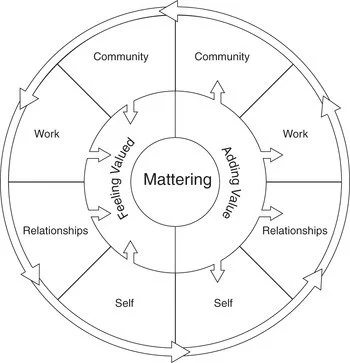
Figure 2. The Mattering Wheel.
Part Three: Finding Flow
Too much challenge can bring on too much stress. But too little challenge can be boring. Having just enough challenge with your current skillset, is the key to being engaged.
This is what psychologist Mihaly Csikszentmihalyi calls a state of flow.The state of flow is where you feel totally engaged, in the zone, and feel that time can pass by quickly.
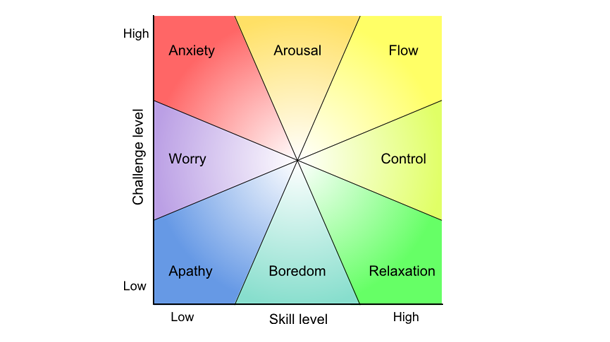
Figure 3. Flow Theory. On the Y axis is the challenge level. On the X axis is the skill level. When you have both high skill level and high challenge level, you can find a state of flow, where you are totally engaged and in the zone.
In his book, Csikzentimihalyi gives the example of playing a game of tennis. If you are a skilled tennis player, and you play with a total beginner, the game can feel really boring. Conversely, if you are a somewhat skilled tennis player and you play with an elite player like Roger Federer, you would be panicking and probably feel the most anxious you’ve ever felt. The key is finding a tennis player that is at your level or slightly higher, so that it offers you enough challenge. With the right amount of challenge level with your skillset, you can play a game where you feel totally absorbed, in the zone, and give you a sense of energy, aliveness, and vitality.
We can apply the concept of finding flow to our career transitions. We can adjust either our skill level or the challenge level. For new clinicians, perhaps the focus should be building crucial clinical skills to build confidence within their role. After some skill building, work is much more enjoyable with less anxiety!
But after five or more years, seasoned clinicians may start to feel bored and want new new challenge. Seasoned clinicians may crave something different: novelty, and career progression. In our career transitions, we may want to find projects or ways to contribute that can challenge us in the appropriate way, so that we can find a state of engagement and flow.
Concluding Thoughts
In contrast to “arrival fallacy”, career crafting is an ongoing and continuous process. You don’t have to wait until a promotion, sabbatical, or retirement to enjoy your unique ways to contribute your skills to the world. Don’t be too busy waiting to achieve your goal, that you miss out on enjoying your career now. What are some ways that you can be more “in the flow”, add value, and feel valued in the current work that you do? For more ideas, check out my previous blog post about job crafting.
A personal note & reflection. Dr. Isaac Prilleltensky was one of my professors during my Master of Applied Positive Psychology program at University of Pennsylvania in 2024. He passed away this year. I will always remember Isaac’s humour, his teaching, his focus and advocacy on community wellbeing. His book, “How People Matter”, was one of my favourite readings and has made an impact in my view of wellbeing.
Suggested Readings
Prilleltensky, I., & Prilleltensky, O. (2021). How people matter: Why it affects health, happiness, love, work, and society. Cambridge University Press.
Csikszentmihalyi, M. (1990). Flow: The psychology of optimal experience. Harper & Row.