

Getting Unstuck: Why Changing Yourself Isn't Enough to Fix Your Happiness at Work.
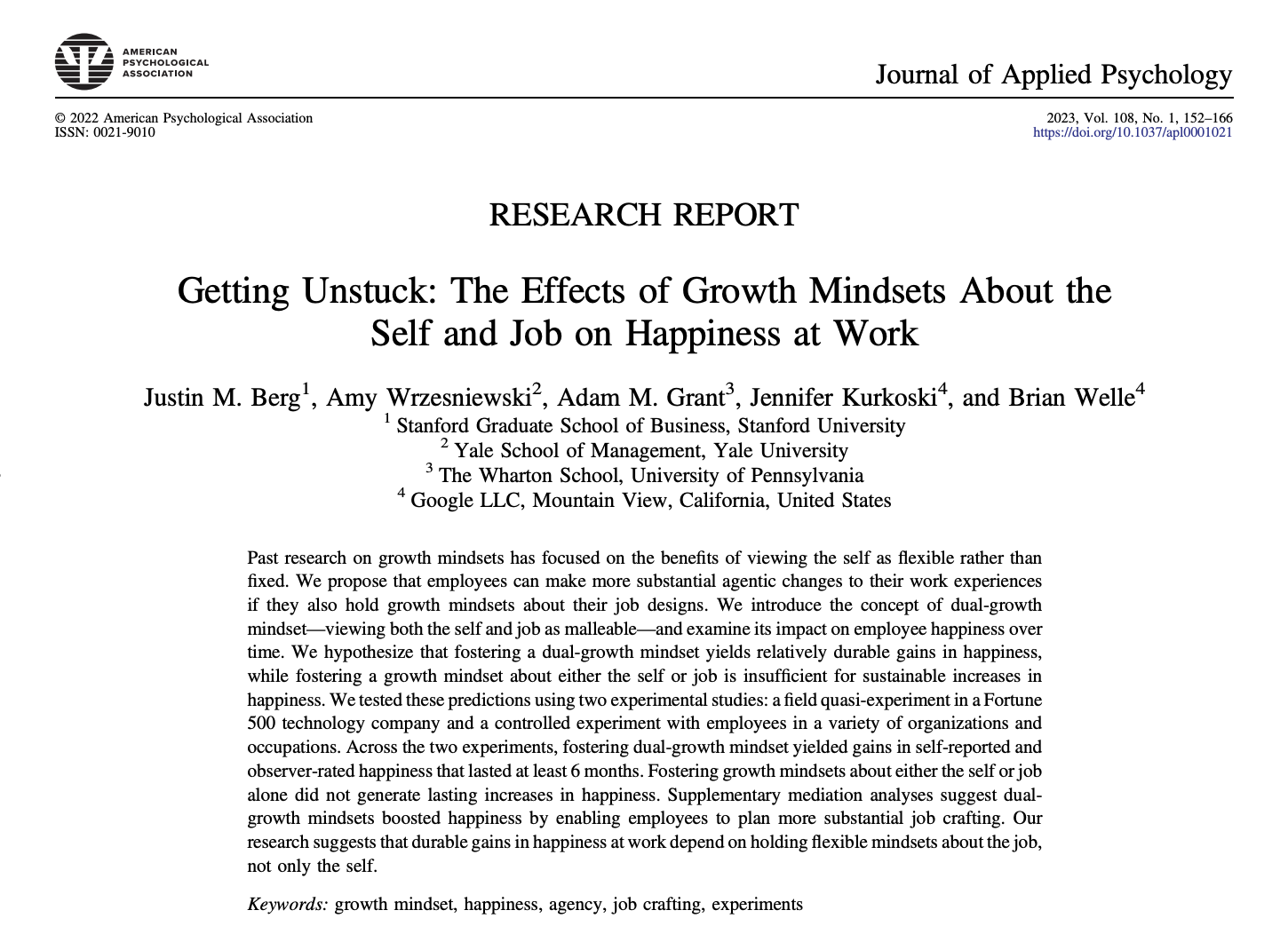
A summary of a study published in the Journal of Applied Psychology by Justin Berg, Amy Wrzesniewski, Adam Grant, and colleagues.
If you've ever tried to "fix" your relationship with work by adopting a new morning routine, or telling yourself to just have a better attitude about your job, you know the drill. The boost fades within weeks. You're not imagining it. There's a well-documented reason for that fade, and new research suggests there's also a way around it.
A study published in the Journal of Applied Psychology by Justin Berg, Amy Wrzesniewski, Adam Grant, and colleagues at Google took a close look at a question that matters enormously to anyone in a high-demand, high-burnout profession: what actually produces lasting happiness at work, and what just produces a temporary bump?
The Hedonic Treadmill Problem
Psychologists have long known about the "hedonic treadmill." It's the tendency for people to adapt quickly to positive changes and drift back to their baseline mood. A raise, a new title, a nicer office: all of it feels great for a while, and then it doesn't. This is part of why burnout interventions in healthcare so often produce a short-lived improvement that evaporates by the next busy rotation.
Growth mindset, the belief that our abilities and traits aren't fixed but can be developed, has been one popular tool for improving engagement at work.
The Missing Half of the Equation
The researchers propose that most growth mindset work has only been looking at half the picture. It focuses on whether people believe they themselves can change. It ignores whether people believe their job can change too. That's the actual bundle of tasks, responsibilities, and relationships that make up their day-to-day work.
Many clinicians experience their job as fixed: the schedule is the schedule, the EMR is the EMR, the patient load is the patient load. But the researchers argue this feeling of fixedness is often more perception than reality. Jobs are usually more flexible than we assume.
They call the belief that your job itself is malleable a job-growth mindset. They call the combination of believing both you and your job can change a dual-growth mindset.
What the Study Found
The team ran two experiments. One took place inside a Fortune 500 tech company. The other was a more controlled study with employees across many different organizations and occupations. In both, people were randomly assigned to a workshop focused on growth mindset about themselves only, their job only, or both together (dual-growth mindset).
The results were consistent:
People who developed a dual-growth mindset were the only group to show a real, lasting increase in happiness. It was still detectable six months later, and it even showed up in ratings from their own managers and coworkers, not just self-report.
People who worked on self-growth mindset alone saw no lasting happiness gains.
People who worked on job-growth mindset alone sometimes got a short-term bump, but it disappeared within weeks.
In other words: believing you can grow, on its own, wasn't enough. Believing your job could change, on its own, wasn't enough either. It was the combination that stuck.
Why the Dual-Growth Mindset Works
The researchers' explanation comes down to something called job crafting: actively reshaping your tasks and relationships to better fit who you are. Their data suggests dual-growth mindset works because it opens the door to bigger, more meaningful job crafting moves.
Think about it this way. If you believe you could develop a new skill, but you also believe your job description is set in stone, there's nowhere to put that new skill to use. Conversely, if you believe your role could change over time, but you don't believe you're capable of growing into whatever that flexed role requires, you'll likely play it safe and stay stagnant.
It's only when both beliefs are in place, I can change, and my job can change, that people start making the kind of substantial, effortful, and genuinely novel changes that are big enough to outrun the hedonic treadmill.
Why This Matters in Clinical Settings
Healthcare is a field notorious for rigid role definitions. Scope of practice, hierarchy, scheduling systems, billing structures all reinforce the sense that a role is set. It's easy to internalize the idea that "this is just how the job is." and feeling stuck, or lost about next steps. Pure self-focused wellness efforts (resilience training, mindfulness apps, "just think positive") may be missing half of what's needed to produce change for more meaningful and engaged work.
Some practical takeaways worth trying:
Notice where you've assumed something about your role is fixed.
Is it actually a hard constraint, or a routine no one has questioned in years?Pair skill-building with role-crafting. If you're developing a new interest or capability (teaching, research, a subspecialty, informatics, mentorship), actively look for a way to fold it into your actual job. Don't treat it as just a side project.
Think in terms of tasks and relationships, not just titles. Job crafting doesn't require a new position. It can mean shifting how much time and energy goes toward certain tasks, or cultivating different working relationships within your existing role.
Give it time. The dual-growth mindset group in this study didn't see full results in the first few weeks. Happiness gains built gradually as people started changing their mindset towards their own abilities and that their job role can change over time.
The Takeaway
Getting unstuck at work doesn't come from believing you can grow, or from believing your job can grow. It comes from believing both at once, then acting on that belief by actively reshaping your work to fit who you're becoming. For clinicians navigating burnout or stagnation, this reframes the wellbeing conversation. It's not just about building resilience in ourselves. It's about giving ourselves permission to see our jobs, even in rigid institutional systems, as more workable than we've assumed.
References
Berg, J. M., Wrzesniewski, A., Grant, A. M., Kurkoski, J., & Welle, B. (2023). Getting Unstuck: The Effects of Growth Mindsets About the Self and Job on Happiness at Work. Journal of Applied Psychology, 108(1), 152–166.